
The Surgeon's Dilemma
- Jun 6
- 4 min read
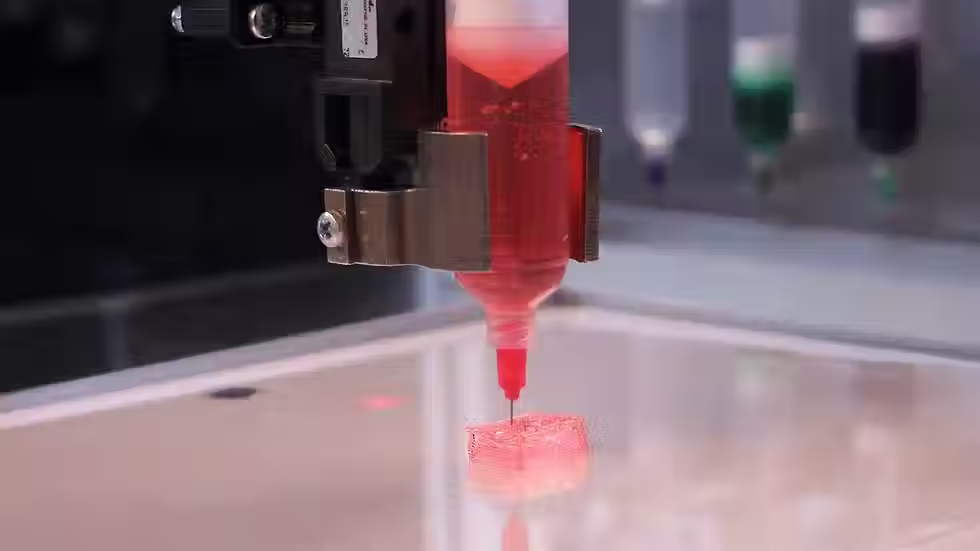
Image Credit - All3DP / Ricardo Pires
Consider a hypothetical scenario in which two patients, admitted simultaneously with identical critical conditions, both require a heart transplant. The first is a young father hanging onto life support. His vitals are dropping, and down the hall, his wife is trying to prepare the toddlers for a reality where Daddy doesn't wake up tomorrow. If he doesn’t receive a transplant tonight, the family will lose everything. The second patient is a brilliant researcher who is on the brink of a huge medical breakthrough that could save billions of lives. However, there is only one donor heart available, and the surgeon must make the ultimate choice. Do you save the pioneer whose work could rescue a generation, or the dying father who is the irreplaceable center of his family's universe?
But what if the surgeon didn’t have to choose? What if the surgeon could perform two heart surgeries? Welcome to the era of 3D bioprinting, where the goal isn't to decide who gets an organ, but simply to print another one.
Let’s go over how this life-changing technology works, step by step, to transform cells into functioning anatomy.
How It Works
Before the organ printer can print cells, it needs a detailed map of the patient’s internal anatomy.
Radiologists use Computed Tomography or a CT scan to capture a high-resolution image three-dimensionally of the patient’s damaged organ. A Computer-Aided Design (CAD) software then converts these images into a 3D model digitally. The software slices this model into thousands of ultra-thin pieces, almost two-dimensional horizontal layers. Think of a loaf of bread being cut into thinner strips of bread. This creates a line-by-line step-by-step digital instruction that tells the printer exactly what to print and where to travel.
Formulating the Bio-Ink
Just like 3D-printing uses plastics or metals to print, an organ printer requires a special material called bio-ink. This medium must protect cells during the printing process and keep them alive later on.
It consists of the patient’s stem cells, which are harvested from the patient’s own blood or skin. These cells are later reprogrammed to develop into specific tissue types like heart cells or blood vessels. The patient’s own cells are used so that their body doesn’t reject the organ.
Bio-ink also consists of hydrogels. It is a nutrient-rich liquid gel that is made from polymers, like collagen. This simulates the body’s natural cell surroundings, providing a moist support system that holds cells in place and gives them the oxygen they need.
Bioprinting
 |  |
After loading the blueprint and the bio-ink, the official printing process takes place. Inside a sterile chamber, the bioprinter’s arm moves precisely to print the organ. Depending on the tissue type, the printer might use extrusion, where it squeezes a stream of thick gel continuously through a nozzle, or light-based printing, where it uses lasers to instantly cure a liquid ink. Layer by layer, the machine outputs the bio-ink, where it slowly builds a three-dimensional structure from the ground up.
Post-Bioprinting
A freshly printed tissue has the consistency of a soft gelatin, so when it’s left on its own, it will collapse into a puddle. To transform it into a functional organ, it undergoes 2 steps:
Cross-linking: The structure is exposed to a chemical trigger or light, like UV or blue light. It causes the polymers in the hydrogel to bond tightly together, allowing the scaffold (temporary framework) to harden so it maintains its shape, almost acting like a skeleton.
The Bioreactor: The hardened structure is then transferred to a bioreactor. It is a chamber that simulates the environment inside a human body. Keeping it at a constant temperature and bathing it in a constant stream of nutrient-rich fluid, the tissue is given time to grow. Over days or weeks, the cells begin to multiply and combine into one, unified network. As the cells take over and create their own natural tissue, the temporary hydrogel safely degrades.
Conclusion
With this new technology on the rise, it can allow surgeons to save multiple lives at once, instead of sacrificing one life over another. However, bioprinting is not yet available for standard clinical procedures just yet, as it cannot fully be vascularized or safely be produced in large masses. Not only that, but this procedure is not yet approved for international standards that approve 3D-printed organs. But with the constant advancements in the medical industry, bioprinting is moving closer to clinical realities, aiming to balance the compromises made in hospitals, ultimately changing the healthcare industry.
References
Bowlby, B. (2025, March 13). Bioprinting and bioinks: the latest innovations in building synthetic
biological structures. BioTechniques. https://www.biotechniques.com/bioengineering-
biophysics/bioprinting-and-bioinks-the-latest-innovations-in-building-synthetic-biological-
Cellink. (2019, March 29). Bioprinting explained (simply!). CELLINK.
https://www.cellink.com/blog/bioprinting-explained-simply/
Gungor-Ozkerim, P. S., Inci, I., Zhang, Y. S., Khademhosseini, A., & Dokmeci, M. R. (2018). Bioinks
for 3D bioprinting: an overview. Biomaterials Science, 6(5), 915–946.
https://doi.org/10.1039/c7bm00765e
Mobaraki, M., Ghaffari, M., Yazdanpanah, A., Luo, Y., & Mills, D. K. (2020). Bioinks and bioprinting:
A focused review. Bioprinting, 18, e00080. https://doi.org/10.1016/j.bprint.2020.e00080
Pires, R. (2018, November 26). What Exactly is Bioink? – Simply Explained. All3DP; All3DP.
https://all3dp.com/2/for-ricardo-what-is-bioink-simply-explained/
(2024). JSM Regenerative Medicine and Bioengineering, -.
https://www.jscimedcentral.com/jounal-article-info/JSM-Regenerative-Medicine-and-
Bioengineering/3D-Bioprinting-in-Tissue-Engineering:-Advancements




Comments