

Eat Meat With 0% Guilt Or Not?
- Mar 23
- 4 min read
Updated: Mar 29

For thousands of years, meat required a heavy tax, a biological one at that: trading a life for a meal. However, in 2026, we are witnessing new advancements that defy that rule. Using a process called cellular agriculture, scientists are now building real animal muscles, promising a flavor that consumers crave without killing a life. It sounds like a great idea to eat meat with 0% guilt. Yet, as scientists start to move this innovative idea to dinner plates, the ideal guilt-free mindset might be more challenging than bioengineers thought it would be.
How It Works
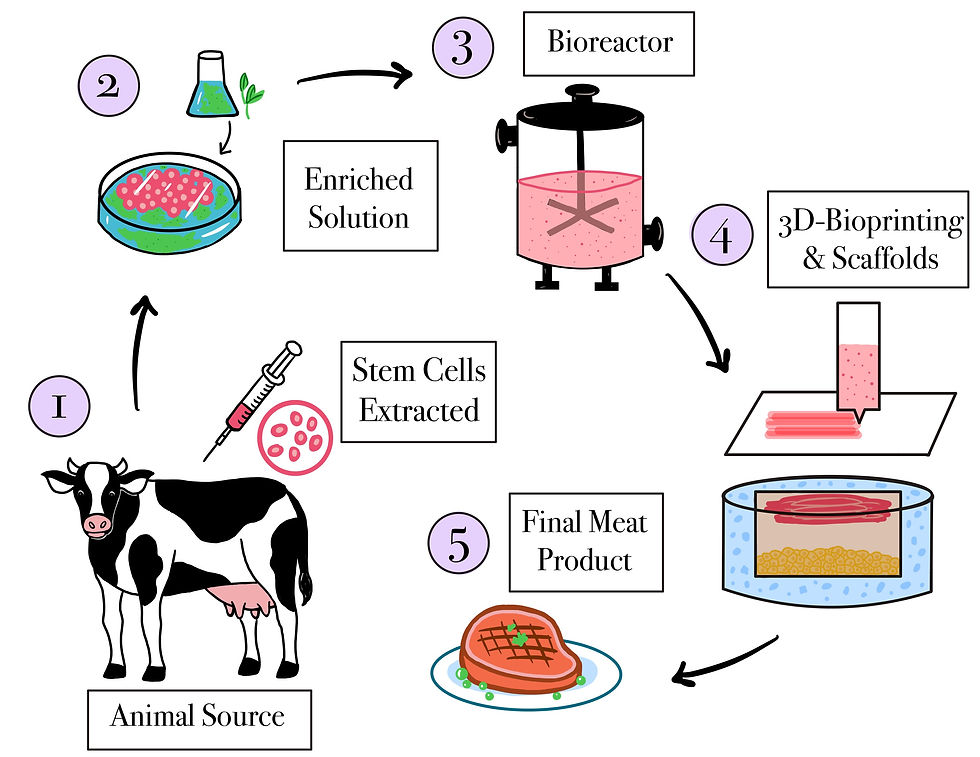
While this idea sounds nice on paper, how does this process work? Stem cells, which can transform into any other type of cell, are extracted from an animal and added to an enriched solution that contains amino acids, salts, sugars, and vitamins. The cells then multiply and convert into muscle, fat, and connective tissue. These cells are then kept in a bioreactor.
In traditional farming, an animal’s body keeps its muscles warm, feeds them nutrients, and flushes out the waste. However, a bioreactor mimics those internal conditions of an animal so that the cells can grow on their own. The bioreactor is essentially a large stainless steel holder that regulates the temperature of the cells, because if it’s too cold, the cells numb, and if it's too hot, the cells die.
The cells also need to breathe, so a device called the sparger blows tiny oxygen bubbles onto the liquid. Think of it like an aquarium bubbler, but with precision, since these are cells we are dealing with.
Just like an animal needs to discard waste, the cells produce trash, like lactic acid and ammonia. A perfusion system constantly filters out the bad stuff, and it pumps in fresh nutrients so that the cells don’t die.
To create meat structures like steaks, the cells are grown on edible scaffolding materials that give the meat its distinctive texture. Edible scaffolding materials are essentially a template or a skeleton for the cell-based meat, where they allow the final result to be similar to the original meat structure.
Finally, after enough cells have multiplied to the extent that enough tissue is grown, the product is harvested from the bioreactor. The results are then processed into final products like sausages and burgers.
Here is the process at a glance:
Why The Lab Wins
Lesser biological risks
Traditional meat is a breeding ground for bacteria like E. coli and Salmonella. Since lab meat is grown in a sterile environment where those risks are reduced, it also prevents bacterial crises by eliminating the need for large amounts of antibiotics used on farms where animals are grown. Farm animals eat and drink all day, but sometimes their food and water aren't always filtered from bacteria. If the farmers don't notice the germs, the animals’ bodies get contaminated as the bacteria spread everywhere. Eventually, this animal is slaughtered and served on a plate, jeopardizing the consumer’s health.
Efficiency of Resources
Meat that is grown in a lab uses 90% less land than meat that is produced on farms. This process has the potential to decrease the amount of water used by a whopping 70-80%. Of course, this depends on how the meat is produced, but overall, it can save a lot of water while producing meat. Even worse, a little over a quarter of the animal is wasted after it is killed for meat. We might think it’s a small number, but it is actually a huge amount of waste. It represents a significant failure to honor the animal's life by using it to its full potential.
The Fine Print
The Price Tag
There are significantly high costs when it comes to the production of engineered meat. Currently, growing a steak is often left for an elite hobby. This is because the nutrients of the cells need time to grow, and the combination of proteins and sugars is perfected to the microscopic level, and this amount of precision is incredibly expensive to produce at large scales. Additionally, lab-grown meat needs a lot of electricity to keep the bioreactors running at specific temperatures all the time.
The Dilemma
Many consumers are hesitant to try out this bioengineered meat because this process isn’t fully animal-free, as it still requires the initial cells needed to multiply into a whole meat. Additionally, while the meat created in a lab has a similar molecular structure to that of meat on a farm, scientists and consumers don’t know the long-term effects that the lab meat might cause.

Image Credit - Food Unfolded
Lab meat definitely has a future, but its success depends on time, scaling, and how the public perceives it, to eat it with 0% guilt.
References
CNBC International. (2024, December 10). Lab-grown meat is on the rise — here’s how it is made.
YouTube. https://www.youtube.com/watch?v=wNlnSMe8imo
Cultured Meat: Better Than The Real Thing? (n.d.). Www.foodunfolded.com.
https://www.foodunfolded.com/article/cultured-meat-better-than-the-real-thing
Khan, A. (2022, February 4). Billions of animals are slaughtered every year — just to be wasted.
Center for Health Law and Policy Innovation. https://chlpi.org/news-and-events/news-and-
commentary/food-law-and-policy/billions-of-animals-are-slaughtered-every-year-just-to-be-
wasted/
Lab-grown meat: What is it made of? Is it healthy? | Farm Forward. (2023, April 27). Farm Forward.
https://www.farmforward.com/news/lab-grown-meat/?
gad_source=1&gad_campaignid=22616155646&gbraid=0AAAAADudVfRxkAaRBNkFtmL-
9yV5EbLtY&gclid=Cj0KCQjwpv7NBhCzARIsADkIfWygbplqxONbrJIdRfUagE-
77DYzrVub1XJHBjhPcuA2Y0gSrzYYp-IaAiMqEALw_wcB
Naysmith, C. (2026, February 26). New Lab-Grown Meat Breakthrough Beats Traditional Beef by a
Mile With 90% Less Land Use, 80% Less Water, and Dramatically Lower Emissions. Yahoo
Finance. https://finance.yahoo.com/news/lab-grown-meat-breakthrough-beats-
The Estimated Amount, Value, and Calories of Postharvest Food Losses at the Retail and
Consumer
Levels in the United States | Economic Research Service. (2025). Usda.gov.
https://www.ers.usda.gov/publications/pub-details?pubid=43836&v=1488.4
World Vegetarian Day. (n.d.). Learnenglishteens.britishcouncil.org.
https://learnenglishteens.britishcouncil.org/study-break/magazine-zone/world-vegetarian-
Zignani, A. (2023, March 29). What is Cultivated Meat? A Guide to Lab-Grown Meat. Mind the
Graph Blog. https://mindthegraph.com/blog/what-is-cultivated-meat/




Comments